
Tent Rentals in Nassau County: A First-Timer’s Complete Guide from Booking to Breakdown
Tent rental in Nassau County involves more decisions, more site-specific variables, and more logistical coordination than most first-time renters expect, and the hosts who navigate it smoothly are the ones who understood the process before they made their first call. From the initial inquiry through post-event pickup, every stage of a tent rental requires decisions that affect your event’s safety, aesthetics, and legal compliance. This guide walks through each stage in sequence, covers the permit and property considerations specific to Nassau County residential installations, and gives you the weather contingency framework that separates a protected event investment from one that is left exposed to Long Island’s unpredictable summer conditions.
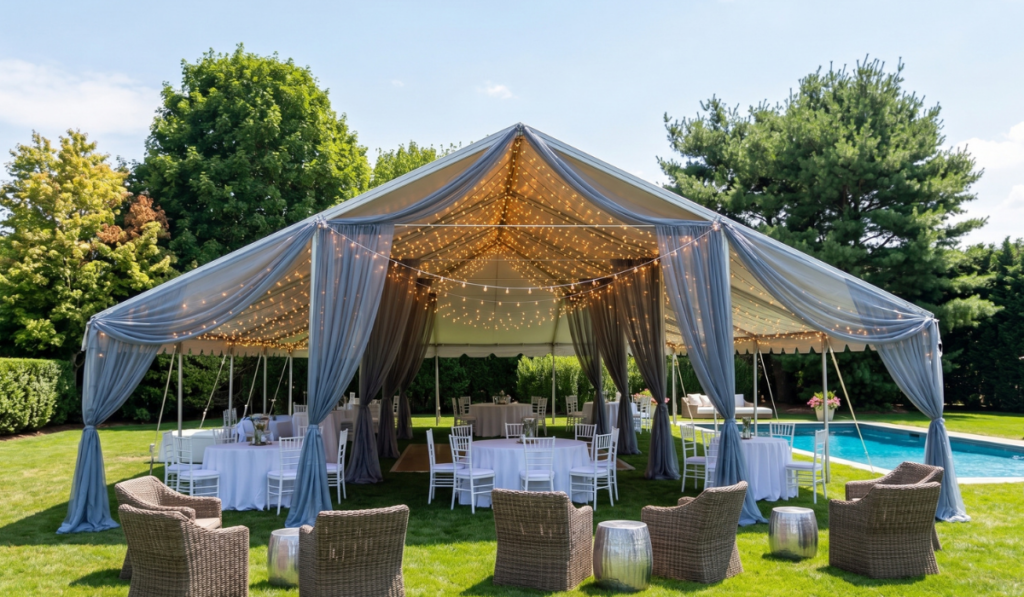
What You Need to Know at Every Stage of the Nassau County Tent Rental Process
The tent rental process has a clear sequence of decisions, and the mistakes that create problems on event day almost always trace back to a decision that was skipped, delayed, or made without the right information. Understanding what happens at each stage gives you the control to avoid those problems entirely.
Stage 1: The Inquiry – What to Know Before You Call
The first call to a tent rental provider in Nassau County sets the trajectory for the entire booking. Hosts who come prepared with the right information get accurate quotes and realistic options. Those who come without it get ballpark figures that often change significantly once the real variables surface.
Before you make your first inquiry, have the following ready:
- Your guest count. This determines the minimum tent footprint. Without it, no provider can give you a realistic size recommendation.
- Your event format. A seated dinner requires 12 to 15 square feet per guest. A cocktail layout needs 8 to 10. A buffet setup adds 50 to 100 square feet for the service area alone. The format changes the tent size, which changes the quote.
- Your yard dimensions and surface type. Measure the usable area, not just the total yard size. Account for pools, patios, built-in features, trees, and anything else that limits where the tent can go. Surface type determines anchoring method: ground stakes for grass and soil, sandbags for pavement and hard surfaces.
- Your event date. Peak season in Nassau County runs May through October. June and July weekends fill first. Knowing your date confirms availability before any other conversation happens.
A site visit from your rental provider before finalizing the booking is worth requesting for any residential installation. Yards that look straightforward from the street often have grade changes, overhead obstructions, or access limitations that only become visible on-site. A professional installer who assesses the property before setup day eliminates surprises that would otherwise surface at the worst possible moment.
Stage 2: Permits, HOA Rules, and Property Line Considerations in Nassau County
Permit and property requirements for residential tent installations in Nassau County are not uniform. They vary by municipality, by tent size, and by how the structure is classified under local code. Most private backyard events with temporary tent structures do not require a permit, but the exceptions matter enough to verify before setup day.
Here is what Nassau County residential hosts need to understand before booking a tent:
Permit thresholds vary by municipality. Some Nassau County villages and towns require a temporary structure permit for tents above a certain square footage, typically 400 square feet or larger. Others have no permit requirement for private residential events regardless of tent size. Contact your local building or zoning department, or ask your rental provider whether they have current knowledge of permit requirements in your specific area. A provider with extensive Nassau County experience will know which municipalities have active requirements and which do not.
HOA restrictions apply independently of municipal permits. If your property falls under a homeowners association, the HOA’s rules about temporary structures, event duration, noise, and guest count may impose restrictions that local code does not. Review your HOA agreement before booking. HOA restrictions are a private matter between the homeowner and the association and are not something a rental provider can navigate on your behalf.
Property line setbacks apply to tent installations. A tent must maintain clearance from property lines, fences, and neighboring structures. The required setback varies by municipality but is typically between 3 and 10 feet. Your rental provider should account for this during the site assessment. If you book without a site visit, measure your available footprint with setback clearance already factored in before confirming a tent size.
Utility line clearance is non-negotiable. No tent stake or anchor point should be placed within the required clearance zone around underground utilities. In New York State, all excavation and ground penetration requires notification through 811 (Dig Safe NY) before work begins. A professional tent installation provider handles this as standard practice. If your provider does not mention it, ask directly whether they have completed the required notification before your setup date.
Stage 3: Weather Contingency Planning – What Your Contract Should Protect
Long Island weather in the May through September event season is genuinely unpredictable. A forecast that looks clear four days out can shift significantly by event morning, and coastal Nassau County locations experience wind and storm conditions that inland areas do not. A tent rental that does not include a weather contingency plan is an unprotected investment, and the time to address that is before you sign the agreement, not after the weather changes.
Here is what a well-structured tent rental contract should address and what you need to confirm before your booking is finalized:
Wind thresholds and deflation policy. The industry standard wind threshold for event tent safety is 35 miles per hour for most frame and pole tent configurations under normal load. At sustained winds above that threshold, the tent should be cleared of guests and, if conditions warrant, deflated or lowered by the installation team. Confirm that your rental agreement specifies the provider’s wind policy and who is responsible for monitoring conditions and making the call to clear the tent.
Sidewall specifications. Sidewalls convert an open tent into an enclosed structure and are the most effective single upgrade for weather contingency. Full sidewalls protect against wind-driven rain, reduce interior wind exposure, and extend the comfort range of the tent by several degrees in cooler weather. For Nassau County events in September and October when evening temperatures drop, sidewalls are a functional necessity rather than an optional upgrade. Confirm that sidewalls are available for your tent configuration and that they are included in or available to add to your booking.
Staking and anchoring specifications. Ask your provider specifically how your tent will be anchored on your surface type. Ground stakes driven at the correct angle and depth into grass or soil provide significantly more holding strength than surface-level anchors or undersized sandbags. For events at locations where deep staking is not possible, confirm the sandbag weight at each anchor point. Industry standard is a minimum of 40 pounds per anchor. Providers who use lighter sandbags as a substitute for proper staking are accepting a safety shortcut that becomes apparent in the wrong conditions.
Cancellation and weather policy. Understand exactly what happens to your deposit if weather forces a cancellation or postponement. Some providers offer a rescheduling window at no additional cost for weather-related cancellations. Others apply the deposit to a future date. The terms vary significantly between providers and should be in writing before any payment is made.
Our Nassau County tent rental configurations include frame and pole tents with full sidewall options, professional ground assessment before every installation, and a team with over two decades of experience navigating Long Island property conditions. You can browse our full party and event rental inventory on Long Island to build your complete setup, or visit our full party and event rental services page to see everything we offer in one place. If you are planning a bridal shower with a tent setup, our bridal shower rental inquiry page lets you submit your date and guest count to get started.
Frequently Asked Questions
Do I need a permit for a tent rental in Nassau County?
Permit requirements for residential tent installations in Nassau County vary by municipality and tent size. Many private backyard events with temporary tents do not require a permit, but some villages and towns require approval for structures above 400 square feet. Contact your local building or zoning department before your event, or ask your rental provider whether they have current knowledge of requirements in your specific area. This question is worth confirming at least four weeks before your event date.
How far in advance should I book a tent rental in Nassau County?
Four to six weeks minimum for most peak season dates. June and July weekend dates book earliest and often require eight or more weeks of lead time to secure your preferred tent size and configuration. For events that also require tables, chairs, linens, and concession equipment, book all items simultaneously to lock in availability across the full rental package for the same date.
What is included in a professional tent rental installation in Nassau County?
A professional tent rental includes delivery, installation, and post-event breakdown and retrieval. Installation covers site assessment, anchoring appropriate to your surface type, and full tent erection including sidewalls if ordered. The installation team confirms all anchor points, checks structural integrity before leaving the site, and coordinates the breakdown window with your event schedule. Hosts are not responsible for any equipment handling before, during, or after the event.
What happens to my tent rental booking if it rains or is windy on my event day?
This depends on your rental agreement’s weather and cancellation policy, which varies by provider. A properly installed tent with sidewalls handles rain without disruption to the event. For extreme wind events above safe operating thresholds, the tent should be cleared of guests per the provider’s weather policy. Review the cancellation and rescheduling terms in your agreement before signing. If your provider does not have a documented weather policy, ask for one in writing before your booking is confirmed.